
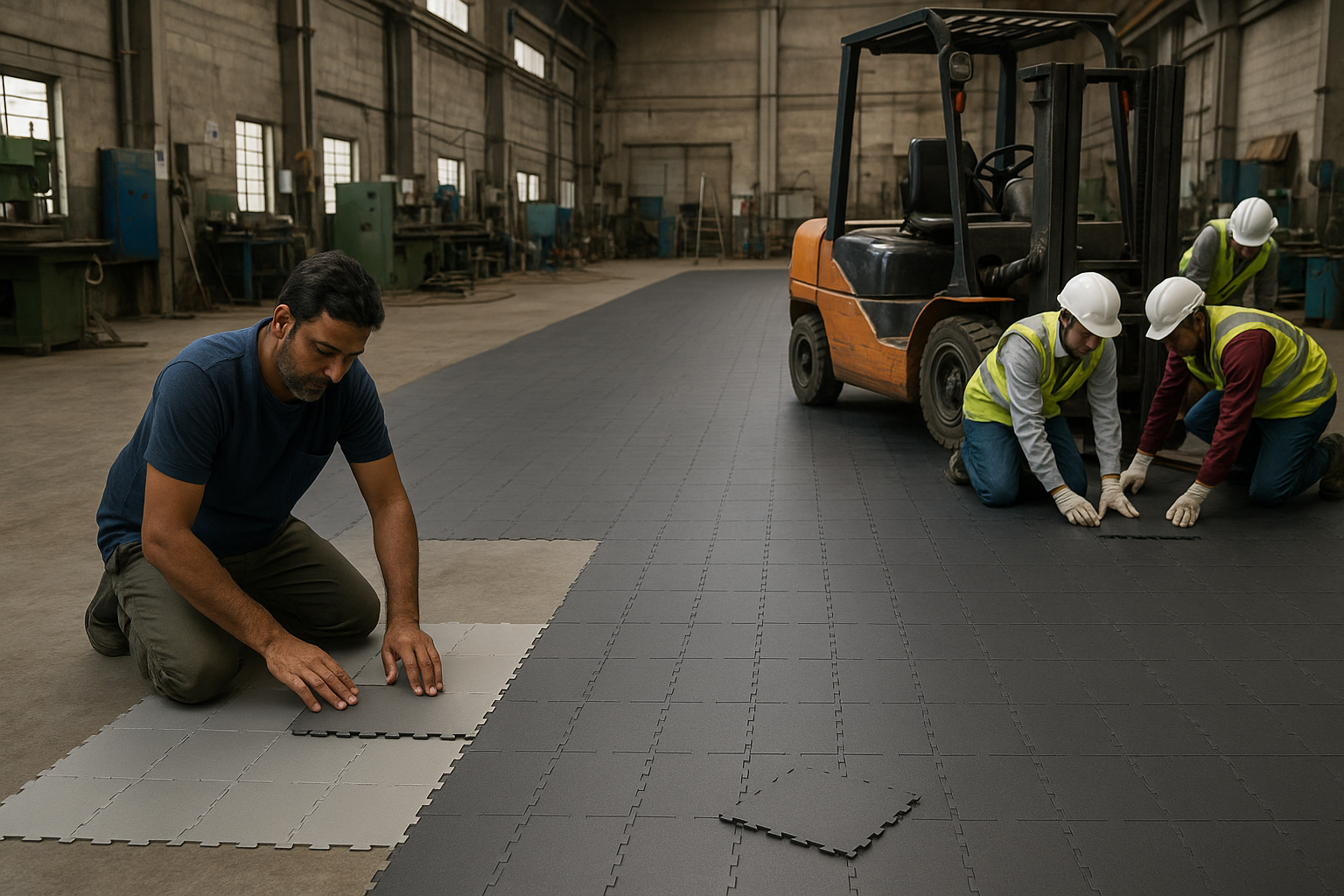
DIY vs Professional Installation: What Industrial Buyers Should Know Before Laying PVC Floor Tiles
CAMP’s Tiepro® PVC interlocking floor tiles are a dry-lay system — no adhesive, no mixing, no specialist chemistry. That simplicity is deliberate, and it genuinely opens the door to self-installation on smaller or simpler floors. But there is a meaningful difference between what is theoretically possible and what reliably delivers a long-service-life installation on a working factory floor.
This post lays out that difference honestly.
What Makes PVC Interlocking Tiles DIY-Accessible
The installation mechanism — click-interlock tile connectors — requires no professional tools, no licensing, and no chemistry. The basic installation process is:
- Clean and assess the substrate
- Plan the grid layout with chalk lines
- Lay tiles row by row with firm downward pressure
- Cut edge tiles with a utility knife or jigsaw
- Fit edge ramps around the perimeter
Most facilities with basic site management capability can execute steps 1–5 on a straightforward floor. CAMP’s step-by-step installation guide covers the full process in detail.
Where self-installation works reliably:
– Areas under 500 sq ft (a single workshop bay, a machine room, an office-to-factory transition zone)
– Rectangular or near-rectangular floor shapes with few obstacles
– Pedestrian-only or light trolley traffic (5mm grade)
– Facilities with an in-house maintenance team who will own the floor ongoing
Where Professional Installation Is the Better Call
1. Large floor areas (1,000 sq ft and above)
The tile count on a large floor is manageable. What becomes non-trivial is maintaining consistent joint alignment across a 100-metre run, managing expansion across multiple bays, and cutting edge tiles accurately at columns, drains, and wall angles. Small alignment errors compound. A professional team works from chalk-line grids established before tile 1 is laid and maintains reference lines throughout the installation.
2. Complex layouts — columns, trenches, drain covers, machinery bases
Cutting tiles around a 400mm column base requires profiling, scoring, and test-fitting. Doing this once is straightforward. Doing it at 15 column positions across a production floor — while maintaining overall grid alignment — is where speed and experience translate into a better outcome.
3. Forklift-rated installations (7mm and 10mm tiles)
The tile is rated for the load. The connector interlock must also be correct — tiles must be fully engaged at every joint, with no debris at the connector, no partial engagement, and no hollow sections. An installation that is 95% correct will show connector failure at the weak joints within the first 3 months of forklift traffic. On heavy-duty applications, professional installation is covered by the manufacturer’s warranty. Self-installation on heavy-duty grades is not warranty-excluded, but substrate preparation and connector integrity are the buyer’s responsibility.
4. Floors with substrate preparation requirements
If the existing floor has loose epoxy, protruding rebar, significant undulations, or active moisture issues, the substrate needs work before tiles go down. Identifying and resolving these conditions requires a site eye. A CAMP project manager will identify substrate issues during the pre-installation floor assessment — issues that a buyer without industrial flooring experience may overlook until the floor is already laid.
5. Phased installation in a live facility
Installing in an operational factory in bays, overnight or across weekends, requires coordination: bay sequencing, temporary route management, equipment protection, and restoration of operational flow in each completed bay before the next is started. An experienced team manages this without disrupting production. DIY phased installation in a live facility is possible but operationally complex.
The Cost Comparison
Professional installation is priced as a per-sq-ft rate that depends on floor complexity, location, and access conditions, and is quoted site-specifically on top of tile cost.
The correct framing is: what does an installation failure cost?
A connector failure on a forklift-bearing section means tiles lifting, potential vehicle destabilisation, and a re-installation. On a 10mm heavy-duty floor, re-installation labour plus any tile replacement is almost always more than the original professional installation cost.
On a 500 sq ft pedestrian-only workshop floor? Self-installation is a reasonable call.
On a 10,000 sq ft counterbalance forklift bay? Professional installation is the lower-risk, lower-total-cost decision.
What CAMP Recommends — Honestly
Self-install is appropriate when:
– Area is under 500 sq ft
– Traffic is pedestrian or light wheeled
– Layout is simple (rectangular, few obstacles)
– The in-house team is confident with basic construction tasks
– The buyer has read and understood the full installation guide
Professional installation is appropriate when:
– Area exceeds 500 sq ft
– Any forklift or heavy pallet truck traffic is planned
– The layout has multiple columns, trenches, or irregular walls
– The facility is live and installation must be phased
– The buyer wants the work covered under CAMP’s installation warranty
The hybrid approach:
Some buyers self-install office and transition zones (5mm pedestrian-grade, simple layout) and use professional installation for production bays and forklift aisles (7mm/10mm, complex layout). This is a reasonable split that reduces total installation cost while protecting the high-load areas.
How CAMP’s Installation Process Works
Whether you are self-installing or commissioning professional installation, CAMP’s process starts with a floor diagnosis:
- Floor photo submission — 2–3 photos showing wide-angle floor condition, surface close-up, heaviest vehicle or equipment
- Use-case review — CAMP’s team confirms tile grade, connector type, and any substrate preparation required
- Installation planning — bay sequence, layout direction, edge treatment specification
- Material dispatch — 5–7 working days from confirmed order
- Installation support — for professional installations, a CAMP project manager attends the site during installation
Self-installing buyers receive the full installation technical guide and can reach CAMP’s technical team by WhatsApp during the installation process.
Frequently Asked Questions
Does self-installing void the tile warranty?
No. CAMP’s tile warranty covers the tile product — the connector, the material grade, the load rating. It is a tiered manufacturer’s warranty whose duration varies by product grade; request your product-specific terms with your quotation. It is not contingent on professional installation. What the warranty requires is correct specification (right grade for the use case) and correct substrate preparation (as specified in the installation guide). If either of those conditions is not met, the warranty does not apply regardless of who installed the tiles.
How long does professional installation take vs. self-installation?
A CAMP professional team installs 2,000–3,000 sq ft per 8-hour shift. A self-installing team with no prior PVC tile experience typically installs 500–1,000 sq ft per day on a straightforward floor — the first half-day is largely learning curve. On large floors, the time difference is significant.
Can CAMP supply tiles only, without installation?
Yes. CAMP supplies tiles, edge ramps, and installation technical documentation. Professional installation is available as an add-on service. The buyer chooses.
What tools are needed for self-installation?
Chalk line and tape measure (layout), utility knife and metal straightedge (straight cuts), jigsaw (curved cuts around columns), rubber mallet (for stubborn connectors on uneven substrates). No specialist tools required.
What if I start self-installing and hit a problem I can’t resolve?
Contact CAMP’s technical team on WhatsApp with photos of the problem. Common issues — connector not engaging, tile rocking on substrate, edge tiles too narrow — all have straightforward solutions. The team has seen every common installation problem and can usually diagnose from a photo.
Planning a PVC Floor Installation?
Whether you’re self-installing or want a fully project-managed installation, it starts with the same step: a floor diagnosis.
Share 2–3 floor photos on WhatsApp and tell us your floor size, use case, and whether you’re planning to install yourself or need a team. CAMP will recommend the right tile grade, flag any substrate issues, and give you a clear installation scope.
Share Floor Photos on WhatsApp →
Read the Full Installation Guide →
CAMP Manufacturing — PVC Interlocking Floor Tiles. Made in India. 5–7 working day delivery. ISO 9001:2015 and ISO 14001:2015 certified.


