
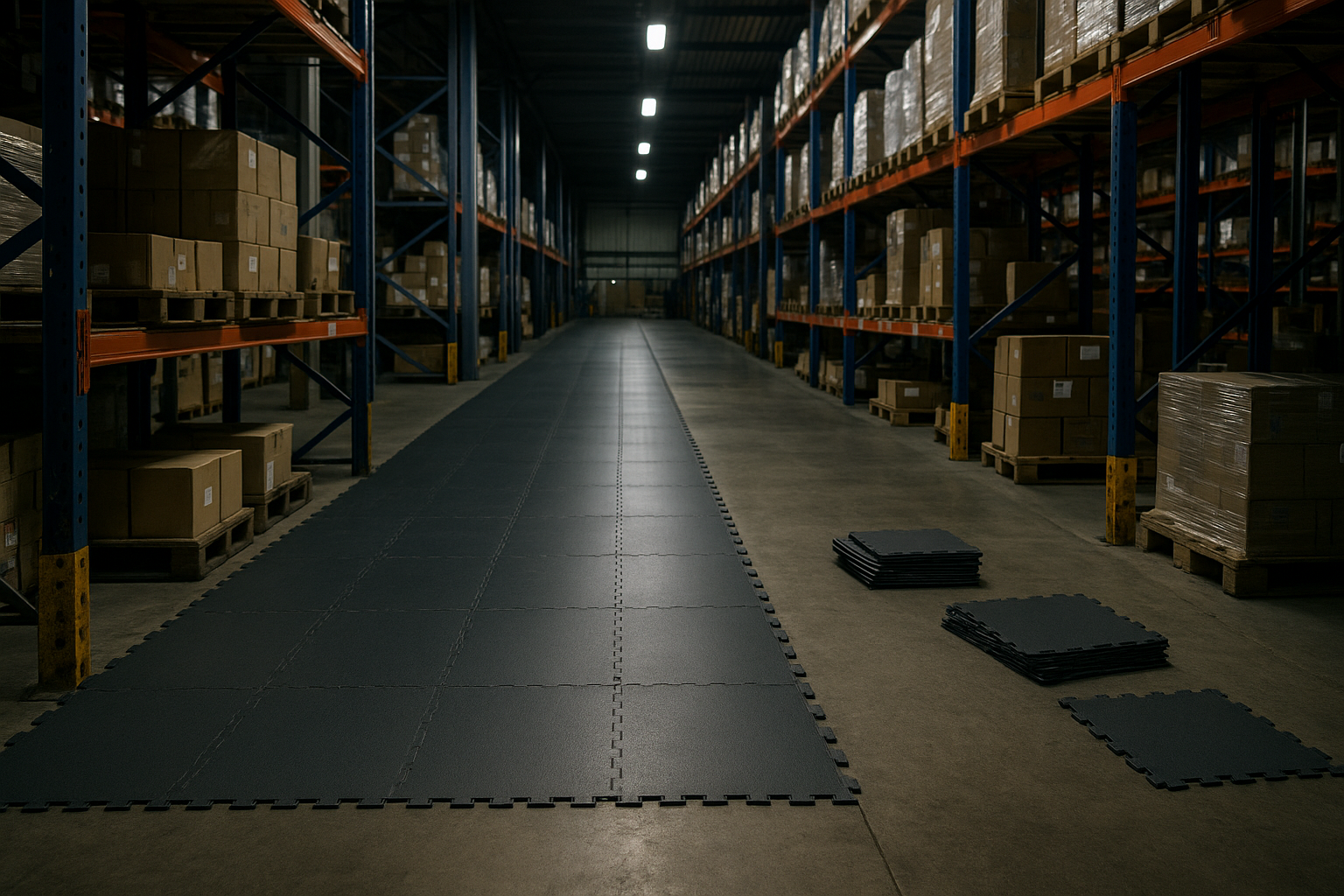
Can You Install New Floor Tiles in a Live Factory Without Stopping Production?
The short answer is yes — with qualifications.
CAMP’s Tiepro® PVC interlocking floor tiles are a dry-lay system. There is no adhesive application, no chemical curing, no off-gassing, and no mandatory drying period. A completed bay is ready for foot traffic immediately. That changes the fundamental constraint of an industrial floor upgrade: you do not need to vacate the entire facility.
What you do need is a phased installation plan, and the conditions for that plan to work reliably.
Why Conventional Flooring Systems Require Shutdown
To understand why phased installation is possible with PVC tiles and not with conventional systems, it helps to understand what those systems actually require:
Epoxy coating
Application requires a clean, dry, controlled-temperature substrate. During application and curing (typically 5–7 days for a full 3-coat industrial system), the surface cannot bear any traffic — foot or vehicle. The cure is chemical; disruption before full cure causes surface failure. For a 10,000 sq ft floor, the facility is essentially a construction site for the full cure window.
Concrete hardener (densifier)
Surface preparation (grinding, shot-blasting) requires heavy equipment and generates dust that must be controlled across the entire affected area. The treatment itself has a curing and settling period. Live production in adjacent areas is possible but practically disruptive.
Vinyl sheet (glued)
Adhesive application requires the surface to be clear, dry, and undisturbed during the adhesive set period. Traffic on wet adhesive zones causes delamination. For large floors, the adhesive and setting logistics require zone clearance.
PVC interlocking tiles
No adhesive. No chemistry. No cure time. A tile laid at 17:00 is weight-bearing at 17:01.
How Phased Installation Works in Practice
A phased installation divides the floor into operational bays — typically aligned to the facility’s existing functional zones — and installs one bay at a time while others remain operational.
Typical bay sequence for a manufacturing facility:
- Start with storage or buffer zones — these carry the least time-critical operations and can be cleared most easily for overnight installation
- Move to maintenance aisles and equipment service areas — lower traffic frequency, easier to reroute during installation
- Finish with primary production bays — the highest operational value, installed last so disruption is minimal and the team has full installation experience from earlier bays
- Transition zones and office-to-factory entries — typically last, as they require careful edge treatment and are visible to visitors
Timeline example — 10,000 sq ft warehouse:
| Day | Area | Sq Ft | Status |
|---|---|---|---|
| Day 1 (Night shift) | Storage zone A | 2,500 | Installed — available for traffic by 06:00 |
| Day 2 (Night shift) | Storage zone B | 2,500 | Installed — available by 06:00 |
| Day 3 (Night shift) | Dispatch aisle | 2,000 | Installed — available by 06:00 |
| Day 4 (Weekend) | Main racking aisles | 3,000 | Installed — available Saturday morning |
Total elapsed time: 4 working nights + 1 weekend. Production continuity: maintained throughout.
What Phased Installation Requires
The ability to phase an installation depends on a few conditions. These are not caveats that undermine the approach — they are site-management requirements that any facility operations team can plan for.
Bay clearance
Each bay needs to be cleared of equipment, racking, pallets, and vehicles before installation begins. For racking-heavy warehouses, this means either temporary relocation of inventory or careful advance sequencing of stock movements. This is a planning task, not a flooring task.
Access for the installation team
The team needs unobstructed access to the bay being installed — typically overnight or during weekend windows. If a production floor runs 24 hours, phasing requires a bay-by-bay maintenance window schedule agreed with operations.
Substrate condition
The substrate in each bay must meet the installation conditions (reasonably flat, clean, free of loose debris or contamination) before tiles go down. Substrate preparation is part of phased installation planning. See the substrate assessment checklist.
Tile grade specified for the full-operational-load use case
A tile installed overnight must be ready for the heaviest traffic the bay will ever see — not light foot traffic during the installation window. The correct specification is a function of grade and thickness together, site-qualified to the actual load. If pallet trucks run through the bay by 08:00, the tile must be specified for standard pallet-truck traffic. If counterbalance forklifts work the aisle by morning, a 10mm heavy-duty grade is the appropriate specification, qualified to the forklift load.
Vehicle re-introduction timing
Foot traffic is immediate. For pallet trucks and light vehicles, allow 24 hours for the tiles to settle under operational conditions before full vehicle movement. For counterbalance forklifts, the 24-hour settlement applies — after which the 10mm tile handles the load as specified.
The Limitation: What Cannot Be Phased
Some floor conditions require prior substrate work that cannot be done bay-by-bay overnight:
- Significant uneven joints or protruding concrete requires grinding — noisy, dusty, requires full-bay clearance and cannot usually be done on the same night as installation
- Active moisture or seepage requires waterproofing treatment before tiles are installed — this is a multi-day process
- Severely delaminating existing epoxy requires removal before PVC tiles can be installed — grinding and removal generate dust and require clearance
If your floor has any of these conditions, the substrate work is scoped separately from the tile installation. In most cases, the substrate work is done in phased bays ahead of the tile installation — adding time but not necessarily requiring a full-facility shutdown.
Where Phased Installation Fits — Representative Scenarios
Phased PVC tile installation suits a range of live-facility settings. The patterns below are representative of how phasing is typically applied — confirm the approach for your own site:
- Automotive component warehouses — racking aisles installed overnight, production bays over weekends, to keep production days running
- FMCG distribution centres — dispatch floor phased in sections while inbound/outbound operations continue in adjacent lanes
- Engineering workshops — machine bay floors completed during planned maintenance windows without extending shutdown
- Pharmaceutical warehouses — floor upgraded with colour-zoning to support GMP requirements (confirm zone-specific compliance and documentation with CAMP) without cold-chain disruption
The consistent factor across these scenarios is that phasing is planned before the first tile is ordered — bay sequence, vehicle rerouting, and substrate preparation all resolved in advance. CAMP has completed 100+ installations across India — including live-facility projects in cities such as Jodhpur and Chennai.
Frequently Asked Questions
Does “no production shutdown” mean operations continue in the same bay during installation?
No. The bay being installed is cleared. What does not stop is production in other bays, adjacent operations, and overall facility throughput. The intent is that the facility does not come to a full halt — not that installation and production share the same floor space.
How many square feet can a professional team install overnight (12-hour window)?
An experienced team installs 2,000–3,000 sq ft per 8-hour shift. A 12-hour overnight window allows proportionally more on a straightforward floor; on complex layouts with multiple columns and obstacles, plan for less.
What if a bay’s substrate needs preparation before installation?
Substrate preparation (grinding, cleaning, levelling) is scoped and scheduled as part of the phased plan. In many cases, substrate prep can be done in one overnight window and tile installation in the next, maintaining the phased approach.
Does the tile installed in one bay connect to the tile in an adjacent bay?
Yes — when adjacent bays are installed, the tiles interlock at the shared edge, creating a continuous floor surface. The junction between bays requires no additional fitting or adhesive.
Is phased installation more expensive than a single full-facility installation?
Slightly, because mobilisation across multiple sessions adds logistical cost. The offset is the production value preserved by not shutting down. For most industrial facilities, the production continuity value is significantly larger than the incremental phasing cost.
Planning a Live-Facility Floor Upgrade?
A phased installation starts with a site-specific plan — bay sequence, substrate conditions, vehicle rerouting, and the right tile grade for each area.
Share 2–3 floor photos on WhatsApp along with your floor size, current operations schedule, and heaviest vehicle. CAMP’s team will scope a phased plan before any tiles are ordered.
Share Floor Photos on WhatsApp →
Read the Full Installation Guide →
View Heavy-Duty PVC Tiles for Factory Floors →
CAMP Manufacturing — PVC Interlocking Floor Tiles. Made in India. 5–7 working day delivery. ISO 9001:2015 and ISO 14001:2015 certified.


