
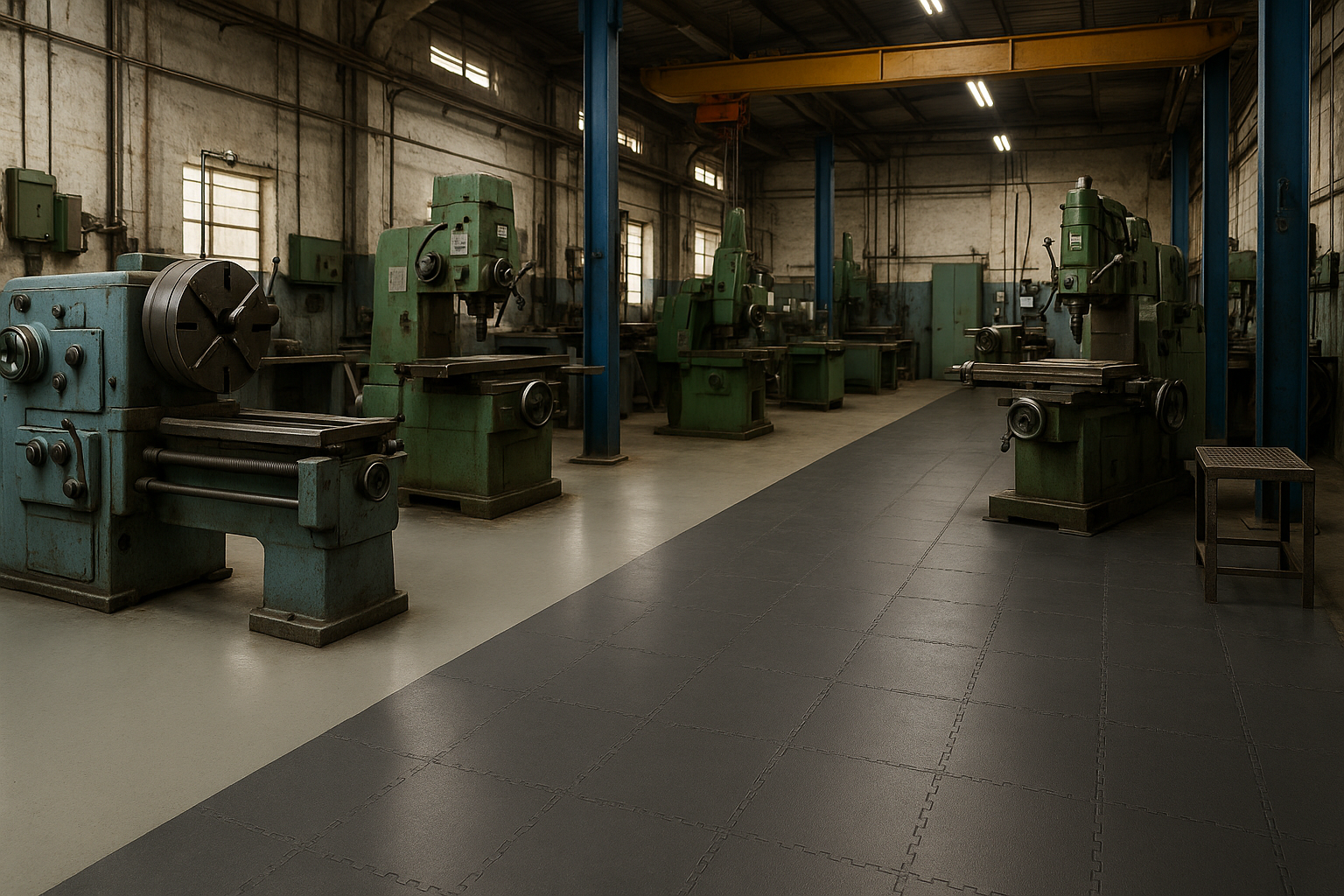
Resin Flooring vs PVC Interlocking Tiles: Which is Actually Better for Your Factory?
Most factory managers think “resin flooring” and “epoxy flooring” mean the same thing. They don’t — and this confusion is responsible for a significant number of expensive flooring specification errors made every year in Indian industrial facilities.
Resin flooring is a category. It covers three fundamentally different chemical systems — epoxy, polyurethane (PU), and MMA (Methyl Methacrylate) — each with different chemistry, different performance characteristics, and different appropriate applications. Specifying epoxy in a situation that requires PU screed is like prescribing paracetamol for a bacterial infection: same category, wrong treatment.
Meanwhile, PVC interlocking tiles are often dismissed as a “lower-spec” alternative to resin. That framing is wrong, and it is costing Indian factory managers money. PVC tiles are not a lower-spec product — they are a different engineering solution that wins decisively in a wide range of factory applications where resin systems struggle.
This guide separates the three resin systems, explains each one with technical precision, and gives you a direct, evidence-based comparison against PVC interlocking tiles across the criteria that matter in a working factory.
What Is Resin Flooring?
Resin flooring refers to any floor surface system that uses polymer resins as the primary binder material. The resin is applied as a liquid or paste to a concrete substrate, where it bonds chemically and cures into a hard, monolithic surface.
The defining characteristic of all resin flooring — the thing that distinguishes it from modular options like tiles — is that it creates a seamless, non-porous, continuously bonded surface. There are no joints, no edges, no gaps. The floor is effectively one continuous piece of material from wall to wall.
This seamless property is resin flooring’s greatest strength in specific applications (hygiene-critical environments), and it is entirely irrelevant in most industrial manufacturing contexts.
The Three Resin Systems — What Each One Actually Is
1. Epoxy Resin Flooring
Epoxy is a two-part system: an epoxy resin and a polyamine hardener. When mixed, they undergo an exothermic chemical reaction (crosslinking) that transforms the liquid mixture into a rigid thermoset plastic.
Key chemistry characteristics:
– Once cured, the molecular structure is rigid and brittle (high hardness but low impact resistance)
– Excellent adhesion to clean, prepared concrete surfaces
– Non-porous, excellent barrier against most chemicals at ambient temperature
– Thermal expansion coefficient is very different from concrete — this mismatch is what causes cracking under thermal cycling
– Moisture sensitivity: uncured epoxy requires a dry substrate; moisture vapour transmission through the slab after application causes osmotic blistering
Practical specifications:
– Thickness range: 100 microns (dust-proof coat) to 6mm (heavy-duty mortar)
– Shore D hardness: 70–85 (very hard, similar to some engineering plastics)
– Compressive strength: 60–80 N/mm²
– Chemical cure timeline: 5–7 days before heavy forklift traffic
– Temperature window for application: 10°C–30°C (critical in Indian summer/winter)
– UV resistance: poor (standard epoxy yellows under UV — use UV-stable formulations if exposure is a concern)
Best honest application: Dry, temperature-controlled environments with light-to-medium traffic. Pharmaceutical dry manufacturing, electronics assembly, general light warehousing.
2. Polyurethane (PU) Screed
PU screed uses polyurethane chemistry — specifically a polyol/isocyanate reaction — to create a floor that cures into a semi-flexible elastomeric matrix rather than a rigid plastic.
This flexibility is the critical difference. Where epoxy bonds rigidly to concrete and cracks when the substrate moves, PU accommodates minor substrate movement without fracturing. It handles thermal cycling (steam cleaning, temperature swings) without delaminating.
Key chemistry characteristics:
– Semi-flexible matrix (Shore D hardness: 55–70 — harder than rubber, softer than epoxy)
– Bridges minor substrate cracks (up to ~0.3mm) without reflecting cracks to the surface
– Excellent resistance to thermal shock: withstands -40°C to +120°C without delamination
– Handles steam cleaning and pressure washing (epoxy cannot)
– Better impact resistance than epoxy at equivalent thickness
Practical specifications:
– Thickness range: 3mm (thin-system) to 9mm (heavy-duty trowel-applied)
– Compressive strength: 45–65 N/mm²
– Return to foot traffic: 12–24 hours
– Return to forklift traffic: 48–72 hours (faster than epoxy)
– Cost: carries a meaningful premium over comparable epoxy systems
– HACCP and BRC certification available — mandatory for food processing
Best honest application: Food and beverage processing, cold storage, wet processing areas, facilities with steam cleaning regimes, any environment with significant thermal cycling.
3. MMA (Methyl Methacrylate) Flooring
MMA is the least well-known of the three resin systems in the Indian market, but it has a specific niche where nothing else competes: situations where the floor must be returned to service in the shortest possible time.
MMA uses acrylic chemistry and a peroxide catalyst system. The curing mechanism is entirely different from epoxy and PU — it is solvent-evaporation based rather than reaction-heat based, which means it is unaffected by low temperatures and cures extremely fast.
Key characteristics:
– Return to foot traffic: 30–45 minutes
– Return to forklift traffic: 1–2 hours
– Suitable for application at -20°C to +35°C (can be applied in cold storage areas at operating temperature)
– Excellent chemical resistance (comparable to epoxy)
– Strong odour during application — significant VOC emission, requires excellent ventilation and PPE
Practical specifications:
– Typical thickness: 2–4mm
– Compressive strength: 70–90 N/mm²
– Cost: significantly the most expensive resin option
– Application requires trained, experienced contractors (the fast cure is an advantage but leaves zero margin for error)
Best honest application: Facilities that genuinely cannot be shut down for more than 2 hours — cold storage facilities being retrofitted at operating temperature, multi-shift operations with 2-hour shift changeover windows, repair patches in critical areas that need immediate return to service.
What Are PVC Interlocking Floor Tiles?
PVC interlocking tiles — CAMP’s range is Tiepro® — are solid-body tiles manufactured from a high-performance engineered polymer composite, designed to be loose-laid over any stable substrate using an engineered tongue-and-groove or peg-socket interlocking joint.
The critical engineering choice that defines PVC tiles — and everything that flows from it — is the decision not to bond the floor covering to the substrate.
This single decision eliminates:
– Moisture-related delamination (no adhesive bond to fail)
– Thermal expansion mismatch cracking (tiles can microshift relative to each other and the slab)
– Minimum cure time (no chemical reaction taking place)
– Minimum surface preparation requirement (no profile needed for adhesion)
– Minimum section size for repair (one tile = minimum repair area)
Technical specifications for CAMP’s industrial tile range:
– 5mm: Pedestrian and light trolley traffic — offices, walkways, quality inspection stations
– 7mm: Standard industrial — pallet-truck and general factory traffic, assembly, manufacturing
– 10mm: Heavy-duty — counterbalance forklift aisles (site-specific qualification for critical or dynamic loads), loading docks (indoor-rated; the compound is UV-stabilised but not for prolonged direct outdoor sun)
– Load rating: determined by grade and thickness together, expressed as UDL and site-qualified to the actual load — not as a single per-tile tonnage
– Surface: Moulded-in anti-slip texture (stud or coin pattern) — permanent, not applied; rated R10 (DIN 51130:2014), certificate on file
– ESD variant: available; ESD performance is gated and confirmed against test documentation on request — no resistance values published
– Chemical resistance: Resistant to mineral oils, hydraulic fluid, and machine coolants; confirm with CAMP for synthetic or aggressive chemical exposure
– Installation rate: 2,000–3,000 sq.ft per 8-hour shift
– Return to service: Immediate — no curing time
Head-to-Head Comparison: Resin Flooring vs PVC Tiles
| Criteria | Epoxy Resin | PU Screed | MMA Resin | PVC Interlocking (7mm) |
|---|---|---|---|---|
| Installation downtime | 5–7 days | 3–5 days | 2–4 hours | None — immediate |
| Surface prep required | Intensive (shot-blast, moisture test) | Intensive | Moderate | Minimal |
| Damp substrate tolerance | ❌ Fails on moisture | ⚠️ Better, needs dry | ⚠️ Limited | ✅ Immune (not bonded) |
| Thermal shock resistance | ❌ Poor | ✅ Excellent | ✅ Good | ✅ Good |
| Heavy forklift (counterbalance) | ⚠️ Cracks over time | ✅ Good | ✅ Good | ✅ Good (10mm heavy-duty grade, site-qualified) |
| Seamless surface | ✅ Yes | ✅ Yes | ✅ Yes | ❌ No (tight joints) |
| Repair method | Grind + recoat section | Grind + recoat section | Patch (fast) | Replace tile — 5 mins |
| Repair cost (2 sq.m) | Section grind + recoat + shutdown | Section grind + recoat + shutdown | Patch + short shutdown | Single-tile material cost only, no shutdown |
| Anti-fatigue | None | None | None | Slight (solid PVC) |
| VOC during install | ⚠️ Moderate | ⚠️ Low | ❌ High | ✅ None |
| Relative material cost/sq.ft | Low–medium | High | Highest | Site-specific quote |
| 5-year TCO (incl. downtime) | High | Medium–High | High | Low |
| Suitable for pharma/food (seamless required) | ✅ Yes | ✅ Yes | ✅ Yes | ❌ No |
| Suitable for damp/moisture-prone slab | ❌ No | ⚠️ With work | ❌ No | ✅ Yes |
| Relocation possible | ❌ No | ❌ No | ❌ No | ✅ Yes — lift and move |
Where Resin Flooring Wins
Scenario 1: Seamless Surface Required by Regulation
If your GMP protocol, FSSC 22000 certification, or FSSAI audit requires a seamless, impermeable floor surface with coved skirtings, resin flooring is the only correct category. There is no compliant tile-based option here. For pharmaceutical dry manufacturing, pharmaceutical liquid filling, food processing, and sterile packing areas, specify PU screed (for flexibility and chemical washdown resistance) or pharmaceutical-grade epoxy (for dry, controlled environments).
Scenario 2: Extreme Chemical Exposure
If your floor will be continuously exposed to concentrated acids (sulphuric, hydrochloric, phosphoric), concentrated alkalis, or solvents at high temperatures, a properly specified chemical-resistant resin system provides better protection than PVC. PVC’s chemical resistance is good for standard industrial exposures (oils, coolants, hydraulic fluid, mild cleaning acids), but aggressive acid chemistry at concentration exceeds its specification.
Scenario 3: Aesthetic Priority (Showrooms, Commercial Lobbies)
Resin floors — particularly epoxy self-levelling in high-gloss or decorative finishes — create a visually premium surface that modular tiles cannot replicate. For reception areas, showrooms, or commercial spaces where visual impression is the priority, resin wins.
Scenario 4: Cold Storage Retrofit at Operating Temperature
This is MMA’s specific application. If you need to floor or repair a cold storage facility without warming it up (because that would cost more in temperature recovery than the floor itself), MMA is the only option. PVC tiles are a practical alternative here too (no cure time, cold-temperature installation possible), but MMA delivers a seamless result.
Where PVC Interlocking Tiles Win
Scenario 1: Live Factory — Cannot Afford Downtime
No resin system installs without measurable shutdown time. Even MMA, the fastest-curing option, requires a 2-hour window minimum. PVC tiles install with minimal shutdown — phased, zone-by-zone, while production continues in the unaffected areas, and each tiled zone is trafficable immediately with no curing time. For a factory operating 6 days a week, the work can often be confined to shift changeover windows and weekends.
Scenario 2: Moisture-Prone Concrete Slab
An old factory slab with rising damp, a poorly cured original pour, or a site with a high water table is the worst possible candidate for resin flooring. The chemistry is simple: moisture vapour migrating upward through the slab accumulates beneath the resin coating, creates osmotic pressure, and causes blistering and delamination. This happens regardless of application quality — it is a physics problem, not a workmanship problem.
PVC tiles, being mechanically interlocked and not bonded to the slab, have no adhesive interface for moisture to attack. They sit on the concrete; any moisture below them simply dissipates naturally.
Scenario 3: Heavy Forklift Traffic in Turning Zones
A 3-tonne counterbalance forklift turning at speed exerts enormous shear force on the floor surface. The forklift’s front drive tires are stationary (or nearly so) while the rear steers — the result is a grinding, scrubbing action that focuses stress in a small contact patch. Epoxy, being rigid and brittle, cracks in this zone. It is not a quality issue — it is a mechanical reality.
For counterbalance-forklift traffic, CAMP’s 10mm heavy-duty tile is the specification — with site-specific qualification for critical or dynamic loads. The tile flexes very slightly under load, distributing the point load across the interlocking joint network rather than concentrating it in a rigid, brittle coating. Individually, a tile handles the load. Collectively, the connected tile field behaves somewhat like a flexible mat.
Scenario 4: Leased Facility
This is often overlooked: if you are in a leased factory, any resin floor you install becomes a permanent fixture that cannot be recovered at lease end. You leave it behind. PVC tiles are lifted, packaged, and moved to the next facility. The asset value is recovered.
On a typical large installation, the recoverable asset value at the end of a lease is meaningful — even accounting for some wear, relocated tile sets retain value.
Scenario 5: Unknown or Damaged Existing Floor
Over an existing cracked epoxy or rough concrete floor that would require significant work to prepare for resin, PVC tiles install without that preparation cost. As long as the substrate is structurally stable and reasonably flat (within 5mm/metre), tiles go on top. The saving versus the grinding, crack repair, and moisture remediation that resin would demand can be substantial on a large floor.
The Specification Decision Framework
Use these three questions to choose between resin and PVC tiles:
Question 1: Does your application specifically require a seamless surface?
→ Yes: You need resin flooring. Choose between epoxy (dry, controlled, light traffic), PU screed (food/pharma, thermal cycling, chemical washdown), or MMA (ultra-fast return to service, cold areas).
→ No: PVC tiles are eligible.
Question 2: Can your facility tolerate a production shutdown for floor installation?
→ No: PVC tiles are the correct choice. No resin system installs without downtime.
→ Yes: Both options are eligible. Move to Question 3.
Question 3: Does your concrete substrate have moisture issues, or is it in uncertain condition?
→ Yes: PVC tiles. Resin systems will eventually fail on problem slabs regardless of application care.
→ No: Both work. Compare TCO and choose based on lifetime cost.
Frequently Asked Questions
What is the difference between resin flooring and PVC tiles in simple terms?
Resin flooring is a liquid applied to your concrete that bonds to it and cures into a seamless coating — like a very thick paint that becomes a hard floor surface. PVC interlocking tiles are solid pre-manufactured tiles that lock together and sit on top of your existing floor without any bonding. Resin creates a seamless surface; PVC tiles create a modular surface with tight but visible joints. Resin requires downtime to install; PVC tiles are ready for traffic immediately.
Is PU screed better than epoxy for Indian factories?
Yes, in most demanding factory environments. PU screed handles the two main failure modes of epoxy — thermal cycling and substrate movement — much better. It carries a meaningful cost premium but has a lower re-coating frequency and better performance in wet or temperature-variable environments. For clean, dry, light-traffic areas, standard heavy-duty epoxy performs adequately and is more cost-effective.
Can I install PVC tiles over existing resin flooring?
Yes, provided the existing resin is not actively delaminating in large sections. If the resin floor is broadly still bonded to the concrete — even if cracked or worn — PVC tiles can be installed directly over it. This is one of the most cost-effective flooring upgrades in a factory: skip the expensive epoxy removal and concrete repair, install tiles directly, and have a forklift-ready floor the same day.
Are PVC tiles a permanent alternative to resin, or a temporary fix?
PVC interlocking tiles are a permanent industrial floor solution, not a temporary workaround. With standard industrial use (pallet trucks, counterbalance forklifts, regular cleaning), expect a long service life before individual tile replacement is needed, backed by a grade-tiered warranty. 10mm tiles are built for heavier-duty conditions. Because damaged tiles are replaced individually, the floor is renewable tile-by-tile rather than as a whole, as long as the underlying slab remains intact.
What thickness PVC tile do I need to match the load capacity of resin flooring?
Match the tile to your traffic, not to the resin. The right grade is a function of grade and thickness together: 7mm for standard pallet-truck and factory traffic — appropriate for most warehouse and factory environments — and a 10mm heavy-duty grade for counterbalance forklift aisles, with site-specific qualification for critical or dynamic loads. Heavy-duty PU screed systems are typically rated higher per the manufacturer’s data sheet; if your forklift loads are at the top of that range, send us the forklift type and wheel load and we’ll confirm the right tile or tell you honestly if a resin system is the better fit.
Is MMA flooring available in India?
Yes, though the contractor network for MMA application in India is smaller than for epoxy and PU. MMA requires experienced applicators because of its fast cure time (approximately 15–20 minute pot life) and high VOC emission during application. Several specialist resin-flooring suppliers offer MMA systems in India with trained contractor networks in major industrial cities — ask any prospective contractor for the system data sheet and their applicator credentials before specifying.
Not sure whether resin or PVC tiles is the right specification for your facility? Share your floor area, forklift type, current floor condition, and any regulatory requirements — we’ll give you a straight specification recommendation. We’ve completed 100+ installations across India — including live industrial sites in cities such as Jodhpur and Chennai — and if resin is the right answer for your specific situation, we’ll tell you that too. Explore the Tiepro® PVC interlocking floor tile range.
See the full head-to-head comparison: Epoxy vs PVC Interlocking Floor Tiles — India’s Most Complete Industrial Flooring Comparison →


