
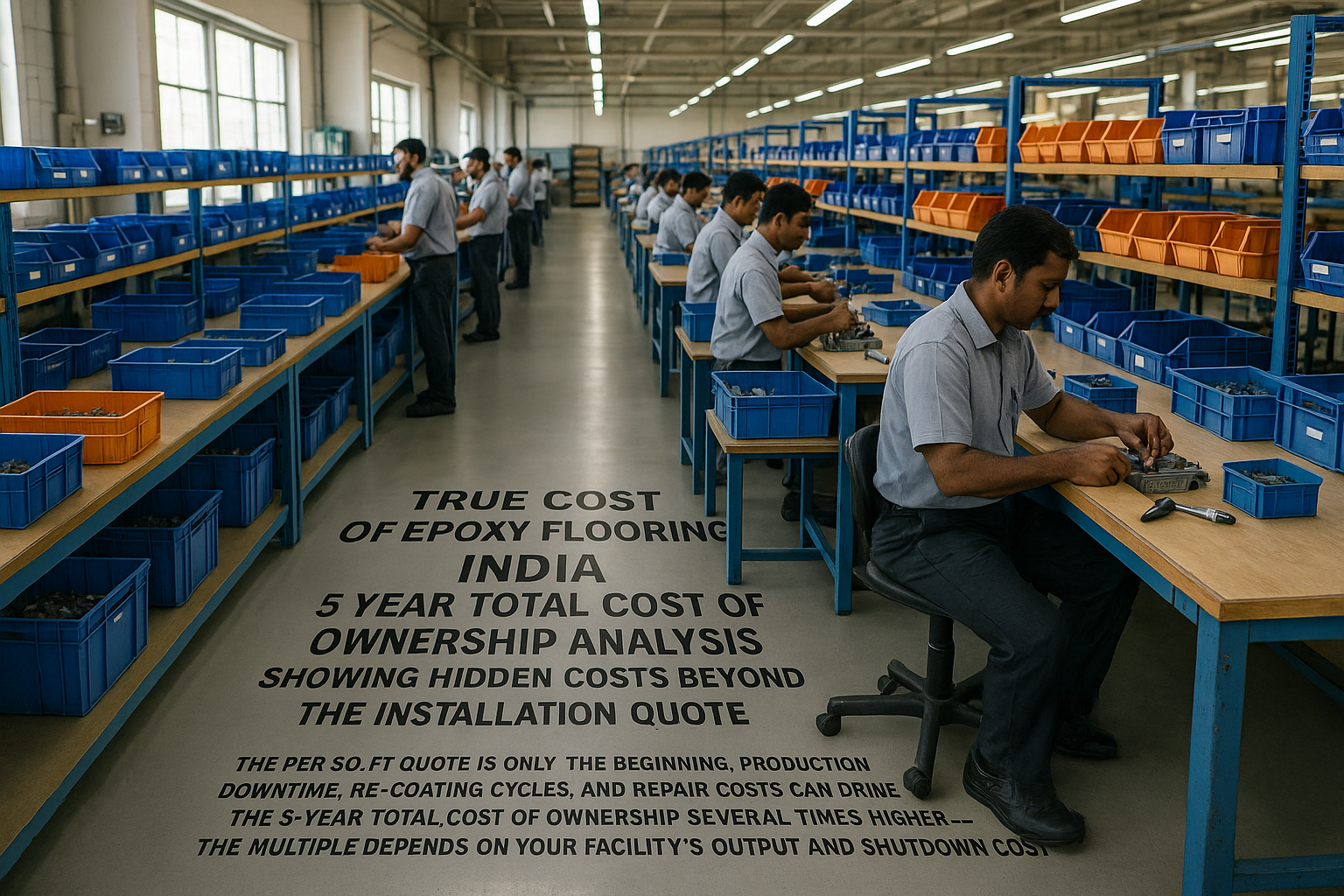
The True Cost of Epoxy Flooring in Indian Factories: What Your Quote Isn’t Telling You
The quote lands in your inbox: a familiar per-sq-ft rate for industrial epoxy flooring. Against the alternatives your contractor mentioned — most of which carry a higher headline rate — epoxy looks like the financially responsible decision.
It often isn’t, in a heavy-traffic plant. And most plant managers only discover that in Year 2.
The epoxy flooring cost in India that you see quoted is the material and application cost. The actual 5-year cost of epoxy flooring includes five additional components that contractors rarely mention and that procurement teams rarely calculate. When you add them up for a typical heavy-traffic Indian factory, epoxy’s Total Cost of Ownership (TCO) routinely comes out several times higher than the initial quote suggested.
This post gives you the full framework so you can run the numbers for your own facility. We deliberately don’t publish a rupee price list — rates move, and the only number that matters is the one for your floor. Instead, we show you every cost category to count, and how downtime usually dwarfs the rest. Read this before you sign the next epoxy quote.
What Epoxy Flooring Actually Costs to Install
Let’s start with what’s on the quote, because even here there are two different numbers — the one you see, and the one you should be paying for.
The Spec You’re Quoted vs the Spec You Need
Epoxy flooring rate per sq.ft in India spans a wide range, because “epoxy” covers genuinely different products:
| Epoxy System | Thickness | Typical Application | Relative Cost |
|---|---|---|---|
| Thin-film / dust-proofing coat | 100–300 microns | Sealing lightly trafficked areas | Lowest |
| Standard self-levelling | 2–3mm | Light-to-medium commercial/industrial | Low–medium |
| Heavy-duty industrial system | 3–5mm | Warehouses, factories with forklifts | Medium–high |
| High-performance / anti-static | 3–6mm | ESD, pharma, food processing | Highest |
The critical problem in the Indian market: most factory floors receive quotes for standard self-levelling or even thin-film systems, when their actual operational demands require the heavy-duty specification.
A 2mm self-levelling epoxy in a factory aisle with a 3-tonne counterbalance forklift will begin showing stress cracks within 12–18 months. The contractor isn’t being dishonest about the material — the material is what was specified. The failure is in the specification match, not the epoxy itself.
So the first lesson is simply: confirm you are being quoted the heavy-duty system your traffic actually needs, not the thin-film coat that shares the word “epoxy.”
Initial Installation Cost for a 10,000 Sq.Ft Floor
The installed cost is more than the headline material rate. Count these categories:
| Cost Item | Counts toward the installed cost |
|---|---|
| Epoxy material and application | The headline per-sq-ft rate × area |
| Surface preparation: shot blasting / diamond grinding | A significant addition — often skipped in cheap quotes |
| Concrete repairs (cracks, spalls, levelling) | Variable, depending on substrate condition |
| Total installation cost | Materially higher than the headline rate alone |
The headline rate climbs once proper surface preparation is included. Contractors who quote an all-in rate that looks too good are typically skipping meaningful surface preparation — which is the single most common cause of epoxy delamination within 24 months.
The 5 Hidden Costs That Drive TCO Up
Hidden Cost #1 — Production Shutdown During Installation
Epoxy installation requires:
1. Clearing the floor area completely of equipment, racking, and inventory
2. Shot-blasting or diamond-grinding the concrete to the correct surface profile
3. Applying primer coat (24 hours drying)
4. Applying body coat(s) (24 hours each)
5. Applying topcoat (24–48 hours)
6. Full chemical cure before forklift traffic: 5 to 7 days
For a full 10,000 sq.ft floor, this is a complete zone shutdown for 7–10 days including preparation.
What does a day of production shutdown cost in an Indian factory?
This is the number to calculate for yourself — it varies enormously by industry and facility size. Build it from two of your own figures:
| Your downtime cost per day = | Lost production value per day + idle labour cost per day |
|---|---|
| Lost production value | Finished-goods output per shift × per-unit margin |
| Idle labour cost | On-site workers who can’t work × their daily cost |
| × shutdown days (5–7 for a full epoxy floor) | = total installation downtime cost |
Run that for your own plant and the result is striking: for most factories, the downtime cost alone exceeds the epoxy material cost several times over.
This is the number that never appears on the epoxy quote. The contractor has no reason to include it. But it is as real as any line item — and it is usually the largest one.
Important caveat: If the factory can phase installation over nights and weekends, or if the zone being floored is genuinely not operational during this period, the downtime cost is reduced. But for most Indian factories with standard day-shift operations and continuous production, a full-floor epoxy installation means a full-floor production halt.
Hidden Cost #2 — The Re-coating Cycle
Standard industrial epoxy in a factory environment with regular forklift traffic does not last 10 years. Industry consensus for a well-applied, properly specified 3–5mm epoxy in high-traffic conditions is:
- Year 1–2: Floor performs as expected. Surface gloss fades slightly but structure is intact.
- Year 2–3: Forklift turning circles begin showing wear through the topcoat. Loading dock areas develop surface cracks where vibration is highest.
- Year 3–4: Full re-coat required for sections with heavy traffic. Optional but increasingly difficult to avoid without creating safety hazards.
- Year 4–5: Either full re-coat or the floor is in poor enough condition to affect safety inspections and hygiene compliance.
The epoxy flooring life for a full re-coat cycle in a heavy-traffic Indian factory is realistically 3 to 4 years — not the 10 years often implied in sales conversations.
Cost of the Year-3 re-coat — categories to count:
| Cost Item | Counts toward the re-coat cost |
|---|---|
| Surface preparation (grinding existing epoxy) | A meaningful share, before any new material |
| New epoxy application (2–3mm resurfacing) | The material + application rate again |
| Production shutdown (4–5 days) | Your daily downtime cost × 4–5 — usually the dominant line |
| Total re-coat cost | Driven mostly by shutdown — comparable to a fresh install in a busy plant |
The point: a re-coat is not a small touch-up. In a high-output plant it repeats most of the original cost, downtime included.
Hidden Cost #3 — Ongoing Repair Cycles
Between the initial installation and the first full re-coat, there will be repair work. In a factory with regular forklift traffic, expect:
- 2–4 patch repairs per year in high-traffic zones
- Each patch repair: materials + contractor fees, plus a 1–2 day partial zone shutdown
These feel small individually. Collectively, over three years, they represent a real maintenance burden on your facilities team and a recurring low-level production interruption — and the cumulative downtime is again the part that hurts.
Hidden Cost #4 — Safety Incidents from Wet/Worn Epoxy
A worn epoxy surface in a factory environment presents a genuine slip hazard. Anti-slip aggregate (typically silica sand or quartz) added to the topcoat wears away within 12–18 months of forklift and foot traffic. What remains is a hard, smooth, non-porous surface that becomes extremely slippery under oil, coolant, or water.
The cost of a worker slip-and-fall incident in India includes:
– Medical expenses and ESI/workman’s compensation claims
– Potential labour court proceedings
– Lost productivity from the injured worker
– Management time for incident investigation and reporting
This is difficult to quantify per sq.ft, but a single serious incident carries significant direct and indirect costs — medical, compensation, lost productivity, and management time. If your floor’s safety performance is degrading, this is a real financial exposure, not a hypothetical one.
Hidden Cost #5 — End-of-Life Removal
When epoxy finally reaches end-of-life — or when you want to switch to a different flooring system — removal is expensive and slow.
Shot-blasting or diamond-grinding old epoxy off a concrete slab adds another per-sq-ft cost on top of several days of downtime — a cost most buyers never factor in at the buying decision.
This is not an issue PVC interlocking tiles have — they are simply lifted and removed, leaving the original floor intact, and the tiles themselves are recoverable, relocatable, and fully recyclable.
The 5-Year TCO: Epoxy vs PVC Tiles
Let’s now build the full 5-year picture for a 10,000 sq.ft factory floor:
5-Year TCO — Heavy-Duty Epoxy (the components to total)
Rather than a rupee figure that would be wrong for your facility, here is the structure to fill in with your own numbers. The shape is what matters: the shutdown and re-coat lines, not the material line, dominate the total.
| Cost Component | Year 0 | Year 1–2 | Year 3 | Year 4–5 | Contribution to 5-Year Total |
|---|---|---|---|---|---|
| Initial installation (material + prep) | ✔ | — | — | — | Moderate |
| Production shutdown (installation) | ✔ | — | — | — | Large — often the biggest line |
| Patch repairs | — | ✔ | ✔ | ✔ | Small but recurring |
| Re-coat (Year 3, incl. shutdown) | — | — | ✔ | — | Large — repeats most of the install cost |
| Safety incidents (worn surface) | — | — | — | ✔ | Variable, potentially large |
| 5-Year Total | Several times the headline install quote |
In a high-output facility, the downtime-driven lines escalate fastest — which is exactly why the per-sq-ft quote is the wrong basis for the decision.
5-Year TCO — CAMP Tiepro® PVC Interlocking Tiles (7mm, Heavy-Duty)
| Cost Component | Year 0 | Year 1–5 | 5-Year Total |
|---|---|---|---|
| Tile material (7mm, quoted per sq.ft by grade) | Site-specific quote | — | Site-specific quote |
| Edge ramps and accessories | Quoted with tiles | — | Quoted with tiles |
| Installation (in-house or CAMP team; 2,000–3,000 sq.ft per 8-hr shift) | Per-shift rate | — | Per-shift rate |
| Production shutdown (phased, zone-by-zone — production continues in unaffected areas) | Minimal | — | Minimal |
| Individual tile replacements (worn/damaged) | — | Material cost only | Material cost only |
| 5-Year Total | Tile material + minimal install, with no re-coating or full-floor shutdown cost |
The structural point is what drives the gap: the PVC side carries no multi-week production-shutdown cost at installation and no re-coating cycle. On the same downtime assumptions used for epoxy above, the modelled 5-year PVC TCO comes out far lower. Treat the comparison as directional — the point is the order-of-magnitude difference downtime drives, not an exact rupee figure. For your floor, request a site-specific quote.
Why The Math Looks So Lopsided
The reason epoxy looks cheap on a quote and expensive in practice is that the quote captures only the direct material cost of the flooring system. It does not capture the operational cost of the facility while the flooring is being worked on.
In manufacturing, time is never free. Every day a production zone is unavailable, the machines and workers in it are either idle or displaced. That cost is absorbed by the business, distributed across every product that would have been produced in that time.
PVC interlocking tiles cost more per sq.ft. They are worth it almost every time in a live factory environment because the installation cost is measured in shifts, not weeks — and the floor is available immediately.
When Epoxy IS the More Cost-Effective Choice
Being fair requires acknowledging the scenarios where epoxy makes financial sense:
New construction with 28+ day settling period: If you are fitting out a new facility with time before operations begin, the production shutdown cost is zero. In this scenario, epoxy and PVC tiles are more directly comparable on material cost, and epoxy can win if the specification is right.
Light-traffic or pedestrian-only zones: A thin-film epoxy coat on a corridor or office area will last 7–10 years with light use. In these zones, the maintenance cycle is much longer and the TCO differential narrows.
Regulatory requirement for seamless surface: If your quality standards, food safety audit, or pharmaceutical GMP requirement demands a joint-free floor, epoxy or PU screed is the only compliant option. In that case, the TCO comparison is irrelevant — the specification is non-negotiable.
Frequently Asked Questions
What is the typical epoxy flooring cost per square foot in India?
Rates move with the market and the system, so treat any published number with caution — a proper heavy-duty industrial system (3–5mm, forklift-rated) costs several times more per sq.ft than a thin-film “budget” coat, and surface preparation (grinding, crack repair) adds further to the installed cost regardless of system type. The figure that actually decides the project, though, is not the per-sq-ft rate — it is the 5-year total once downtime and re-coating are counted. Use the framework above to build it for your own floor.
How long does epoxy flooring last in an Indian factory?
Under heavy forklift traffic and standard industrial conditions, a well-applied 3–5mm epoxy system typically requires re-coating within 3–4 years. In light-traffic areas, 5–8 years is achievable. The epoxy flooring life is significantly reduced by moisture in the substrate, poor original surface preparation, or exposure to thermal cycling.
What is the most cost-effective industrial flooring for India in the long run?
For most manufacturing facilities (assembly, warehousing, packaging, machining, automotive supply chain), PVC interlocking tiles at 7–10mm have the lowest 5-year TCO because they eliminate production shutdown costs at installation and avoid re-coating cycles. The only exceptions are applications requiring a seamless surface or extreme chemical resistance that exceeds PVC’s specification.
Can I install PVC tiles on top of existing epoxy to avoid replacement costs?
Yes. If the existing epoxy is structurally bonded (not actively delaminating in large sections) and the floor is reasonably flat, PVC tiles can be installed directly over the old epoxy surface. This is one of the most common retrofitting scenarios we encounter — it avoids the cost of epoxy removal and gives the floor immediate new capability.
How do I calculate production downtime costs for my facility?
Multiply your daily production output value (total finished goods produced in a shift × the per-unit revenue) by the number of shutdown days. Then add idle labour costs (all workers on-site who cannot work × their daily cost). A rough rule of thumb: the true operational cost of a factory floor shutdown is 2.5–3.5× the direct production loss alone when you include idle labour, lost delivery commitments, and recovery overtime.
Is PVC flooring cheaper than epoxy overall?
The tile material itself is typically more expensive per sq.ft than basic epoxy. However, because PVC installs with minimal shutdown — phased, zone-by-zone while production continues in unaffected areas — the total installed cost and the 5-year maintenance profile make PVC tiles significantly cheaper in total cost of ownership for most production environments.
Before you sign your next flooring quote, get a comparative analysis. Share your factory floor area, current flooring condition, and operation type with us — we will build a side-by-side 5-year cost comparison of epoxy and CAMP’s Tiepro® PVC tile system, including a realistic downtime calculation for your specific situation, and prepare a site-specific quotation. We don’t publish a blind rate — your floor gets its own number.
See the full head-to-head comparison: Epoxy vs PVC Interlocking Floor Tiles — India’s Most Complete Industrial Flooring Comparison →


