
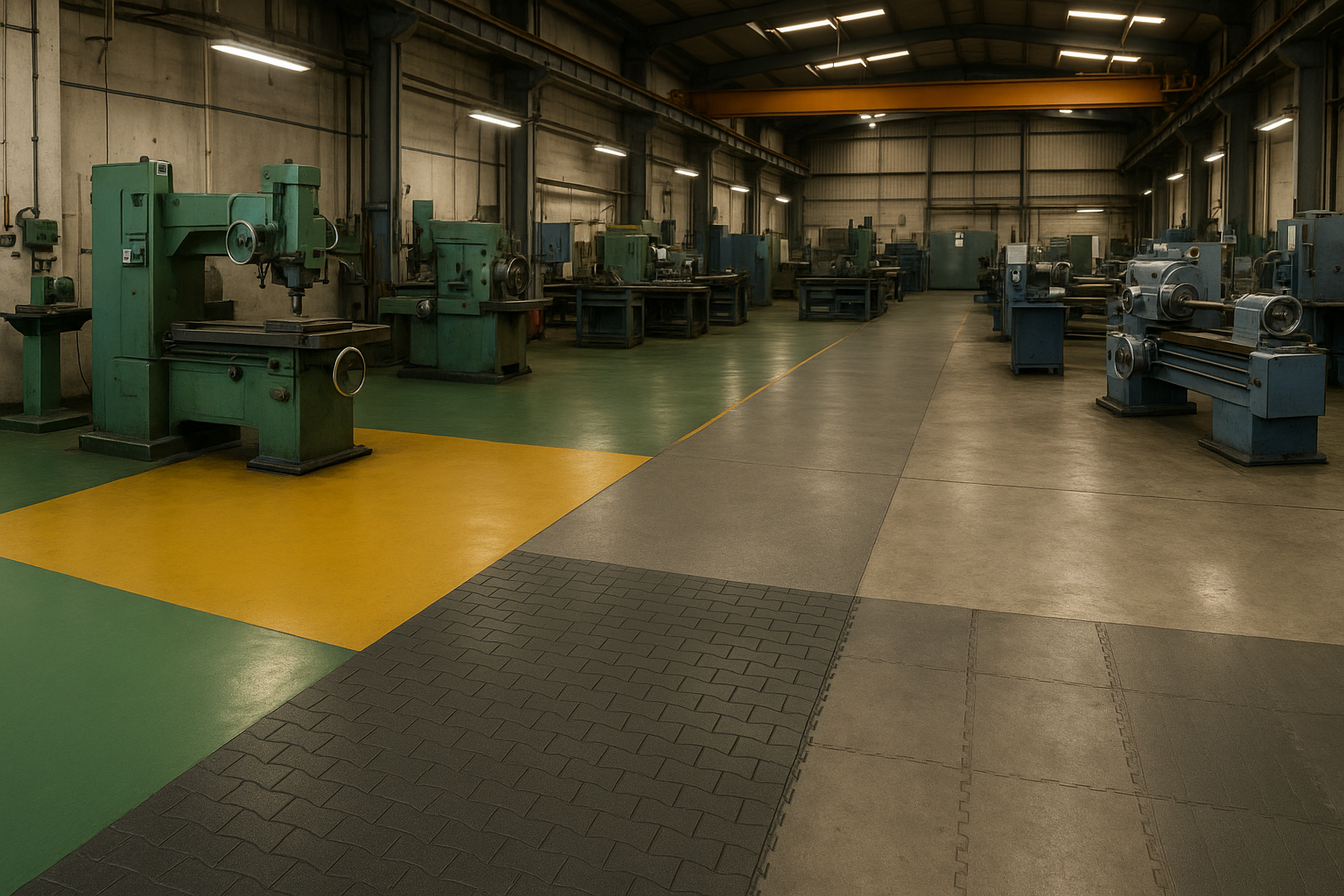
Factory Flooring Options in India: Epoxy, PU Screed, Rubber, Concrete & PVC Tiles — An Engineer’s Comparison
Here is the conversation that happens in almost every Indian factory, at least once:
A contractor quotes a familiar per-sq-ft rate for standard industrial epoxy. The plant manager approves it. Some months later, the forklift aisle is cracked, the loading zone is peeling, and the maintenance team is patching it with whatever the hardware store carries. Before long, the whole floor needs re-coating — and another stretch of production shutdown.
The problem was not the contractor. The problem was that “industrial epoxy” was the only flooring option anyone presented.
There are six main factory flooring alternatives available in India today, and each one wins in a specific scenario. Choosing the right material for your actual operating conditions — not just the cheapest or most familiar — is the decision that separates a floor that lasts for years from one that needs re-doing on a short cycle.
This is an engineer’s guide to all six options, with real numbers, real trade-offs, and a direct recommendation framework at the end.
Why Factory Floor Choice Matters More Than You Think
A factory floor is not a passive surface. It is under constant assault: forklift tires grinding into turning circles, machine coolant pooling around lathes, dropped steel components hitting with point loads of several tonnes per sq.ft, and vibration from heavy presses cycling 8 hours a day.
Each of these stresses interacts differently with each flooring material. A system that handles one beautifully can fail catastrophically under another.
The cost of that failure is rarely just the material. It is the production shutdown to repair it — typically 3 to 7 days for any resin-based floor — multiplied by the daily output value of your facility. For most working factories, several days of lost output during a floor repair costs more than the original flooring installation — which is exactly why the comparison that matters is total cost of ownership, not the per-sq-ft rate.
Before choosing any industrial flooring option, answer four questions:
1. What loads will it take — foot traffic, pallet jacks, forklifts, or loaded HGVs?
2. What chemical or fluid exposure does it face — oils, coolants, acids, water?
3. How much downtime can you tolerate for installation or repair?
4. Is it a permanent facility or a leased space where you may need to recover your investment?
The answers will narrow your decision significantly.
The 6 Main Factory Flooring Options in India
Option 1 — Bare/Hardened Concrete (VDF or Treated)
Bare concrete — when properly specified and finished — is frequently the most underrated factory flooring option in India.
Modern concrete factory floors are not raw poured slabs. Vacuum Dewatered Flooring (VDF) uses vacuum suction during pouring to remove excess water, resulting in concrete with significantly higher surface density, abrasion resistance, and compressive strength (typically M25–M35 grade) compared to standard poured slabs.
Surface hardeners (either metallic or non-metallic dry-shake compounds) are then applied to the fresh concrete to create an extremely tough, abrasion-resistant surface. When sealed with a penetrating chemical sealer, the floor is dustproof, reasonably chemical resistant, and capable of handling any forklift or heavy machinery load.
Where it wins: New construction, very high load environments (>10 tonne forklift), facilities with very tight budgets, long-term owned facilities.
Where it fails: Existing facilities where the floor is already laid and cannot be ripped up. Doesn’t work for retrofitting. Also: any crack in concrete — even hairline — will telegraph upward through any coating applied later.
Cost: among the lowest per-sq-ft of all options for VDF + hardener on new construction. Retrofitting existing concrete is a different (much more expensive) conversation.
Downtime for installation: 28–35 days for new concrete curing. Not applicable for retrofit.
Option 2 — Epoxy Resin Flooring
Epoxy is a two-component thermosetting polymer — a resin and a hardener that, when mixed, chemically bond into a rigid plastic-like surface. It is the most widely specified factory flooring in India, primarily because it has been around the longest and most contractors know how to apply it.
Standard industrial epoxy thickness ranges from thin-film dustproofing coats (100–300 microns, essentially just a sealer) to self-leveling systems (2–3mm) to heavy-duty mortars (4–6mm). The last category is what most factories actually need, though thin-film is often what they actually get.
Genuine strengths:
– Seamless, non-porous surface (excellent for hygiene requirements)
– Very high chemical resistance against oils, mild acids, and most industrial solvents
– Can be specified with anti-static/ESD properties
– Strong initial aesthetics — hard, high-gloss, professional appearance
Real limitations that contractors often understate:
– Rigidity is its Achilles heel. Epoxy has zero flexibility. When the concrete substrate beneath it expands (in India’s climate, concrete slabs can shift 2–5mm seasonally), the epoxy cracks. This is not a defect — it is physics.
– Moisture is its enemy. Any moisture in the concrete slab — from rising damp, poor original curing, or hydrostatic pressure — will migrate to the epoxy-concrete interface and cause blistering and delamination. Many older Indian factory slabs have this problem.
– Full shutdown required. Proper application requires grinding the concrete to a surface profile (CSP 3 or 4), priming, and multi-coat application. Full curing before forklift traffic is 5–7 days minimum. For a 24/7 facility, that lost production is usually the largest single line in the true cost.
– Repairs are disproportionately expensive. A cracked 2m² section cannot be patched invisibly. Contractors grind the patch edges, apply new material, and the colour match is rarely perfect. In high-traffic zones, this repair cycle recurs.
Cost range: a proper heavy-duty industrial specification (3–5mm) costs several times more per sq.ft than a thin-film “budget” coat — and that thin-film coat is not appropriate for forklift environments, even though it is often what gets quoted.
Downtime: 5–7 days (full installation). 2–3 days for major section repair.
Best for: Light-to-medium traffic areas, dry environments, pharma/food zones where a seamless surface is mandatory, clean rooms.
Option 3 — Polyurethane (PU) Screed
If epoxy is the workhorse of Indian factory flooring, PU screed is the thoroughbred — higher performing, more capable in demanding conditions, and correspondingly more expensive.
PU screed is also a two-component system, but the chemistry is fundamentally different. Where epoxy cures into a rigid thermoset plastic, PU crosslinks into a semi-flexible elastomeric structure. This flexibility is what makes PU systems categorically superior to epoxy in several critical scenarios.
Technical specifications:
– Applied thickness: 3mm (standard), 6–9mm (heavy-duty trowel-applied)
– Temperature resistance: -40°C to +120°C (food/cold storage compatible)
– Flexibility: Can bridge hairline cracks in the substrate (up to ~0.3mm) without cracking itself
– Thermal shock resistance: Can withstand sudden temperature changes, including steam cleaning (epoxy cannot)
– Typical compressive strength: 45–65 N/mm² (higher than most epoxy systems)
– Return to light foot traffic: 12–24 hours. Forklift traffic: 48–72 hours.
Where PU wins decisively over epoxy:
– Food processing and FMCG facilities requiring steam cleaning
– Cold storage and temperature-cycling environments
– Areas with constant wet processing or acid washdowns
– Heavy impact zones (automotive manufacturing, metal fabrication)
– Any facility where the concrete substrate is known to have minor movement
Where PU is the wrong choice:
– Standard dry warehouses where basic epoxy works fine and the budget is tight
– Any renovation where the specification budget doesn’t allow for it (PU carries a meaningful premium over equivalent epoxy)
Cost range: the highest per-sq-ft of the resin systems here, depending on thickness and system specification.
Downtime: 3–5 days total (similar to epoxy, slightly faster return to traffic).
Option 4 — Rubber Flooring
Rubber flooring deserves an honest treatment: it is excellent in its intended applications and inappropriate in most factory environments where it tends to be specified.
Industrial rubber tiles are vulcanised rubber products available in rolls or tiles. Their properties are anti-fatigue (absorbs the impact of standing), sound dampening, and excellent grip. They are the correct specification for assembly stations, quality inspection areas, standing workbenches, and anywhere worker ergonomics are the primary concern.
What rubber does well:
– Anti-fatigue: reduces musculoskeletal strain for workers standing 8+ hours
– Sound dampening: reduces noise transmission in areas near heavy machinery
– Natural grip: good slip resistance in wet and dry conditions
– Warmth: less thermally conductive than concrete or hard tiles
What rubber cannot do:
– Handle forklift traffic: steel wheels on rubber cause accelerated wear and deformation. Rubber mats under forklift zones will be destroyed within weeks.
– Resist industrial oils and solvents: petroleum-based products swell and degrade rubber. Machine coolant will destroy rubber mats over time.
– Scale economically for large areas: rubber is expensive per sq.ft and difficult to replace in sections once degraded.
– Tolerate heavy point loads: a dropped steel component will cut or permanently indent rubber tiles.
Cost range: industrial-grade vulcanised rubber is expensive per sq.ft — among the highest here for a full-area floor. Anti-fatigue matting at specific workstations is a far more cost-effective application.
Best for: Ergonomic workstations only. Do not specify for traffic aisles, loading zones, or any area with regular forklift activity.
Option 5 — Ceramic/Vitrified Tiles
Briefly: vitrified tiles are not industrial flooring. They are specified in factories occasionally because they look clean and the procurement team is familiar with them from commercial construction.
The failure mode is predictable: a single dropped wrench creates a permanent chip or crack. A forklift tire catches the edge of a tile and shears it. The grout joints accumulate oil and become impossible to clean. One cracked tile in a pedestrian walkway becomes a tripping hazard and a liability.
The only legitimate factory application for high-quality vitrified tiles is office areas, reception, and washrooms within a factory building — not the production floor itself.
Option 6 — PVC Interlocking Floor Tiles
PVC interlocking floor tiles — such as CAMP’s Tiepro® range — are solid-body, heavy-duty tiles moulded from a high-performance engineered polymer composite that lock together with an engineered interlocking joint system — no adhesive, no levelling compound, no chemical bonding to the floor.
This distinction — the fact that they float over the existing slab rather than bonding to it — is what gives them a fundamentally different set of properties compared to all resin-based systems.
Key technical characteristics:
– Thickness: 5mm (pedestrian and light trolley traffic), 7mm (standard industrial — pallet-truck and general factory traffic), 10mm (heavy-duty — counterbalance forklift aisles, with site-specific qualification for critical or dynamic loads)
– Material: solid-body high-performance engineered polymer composite (no hollow core)
– Load rating: determined by grade and thickness together, expressed as UDL and site-qualified to the actual load — not as a single per-tile tonnage
– Anti-slip: moulded-in surface texture (studded or coin) — no applied coating to wear off; rated R10 (DIN 51130:2014), certificate on file
– ESD variant: an electrostatic-dissipative configuration is available on request; ESD performance is characterised against test documentation, which we share on request — we do not publish a CAMP resistance value until certification is on file
What makes PVC tiles categorically different for factory applications:
No curing time — minimal shutdown. An experienced team installs 2,000–3,000 sq.ft per 8-hour shift. The floor is available for traffic immediately after the last tile is tapped in — no curing time. Installation runs phased, zone-by-zone, so production continues in unaffected areas. There is no “wet” phase, no chemical reaction happening, nothing to protect from traffic or contamination.
Moisture below the floor is irrelevant. Because the tiles are not bonded to the concrete, hydrostatic pressure from below simply has nowhere to act. There is no adhesive bond to delaminate, no coating to bubble. The tiles sit on the slab; moisture below them simply has no mechanism to damage the tile above.
Individual tile replacement. If a tile is cut by a dragged steel edge, cracked by an extreme point load, or simply heavily worn in a high-traffic zone, that tile is removed (a mallet and pry tool, 2 minutes) and a replacement tapped in. The cost is one tile. There is no minimum repair area, no colour-matching, and no curing time before the zone is back in use.
Installed over damaged floors. One of the most common applications is installing PVC tiles directly over failing epoxy or damaged concrete — eliminating the cost of epoxy removal and concrete repair. As long as the substrate is structurally sound and reasonably flat (within 5mm variation per metre), tiles go down directly on top.
Where PVC tiles have genuine limitations:
– Not suitable for applications requiring a 100% seamless surface (pharma GMP environments, food processing areas with HACCP joint requirements)
– Not appropriate for areas with continuous pooling of aggressive acids or solvents at concentrations that would degrade PVC
– Outdoor unprotected areas (UV degradation over time without UV-stabilised formulation)
Cost: Quoted per sq.ft by grade across CAMP’s 5mm–10mm range — site-specific quote only. No installation adhesive cost. Minimal surface prep cost.
Full Comparison Table: All 6 Options
| Criteria | Bare Concrete (VDF) | Epoxy Resin | PU Screed | Rubber | Ceramic/Vitrified | PVC Interlocking |
|---|---|---|---|---|---|---|
| Installation downtime | 28–35 days (new) | 5–7 days | 3–5 days | 1–2 days | 2–3 days | Immediate |
| Heavy forklift handling | ✅ Excellent | ⚠️ Cracks over time | ✅ Good | ❌ Poor | ❌ Poor | ✅ Good (10mm heavy-duty grade, site-qualified) |
| Moisture resistance | ⚠️ Needs sealing | ❌ Fails on damp slabs | ✅ Good | ❌ Degrades | ⚠️ Grout absorbs | ✅ Not bonded — immune |
| Chemical resistance | ⚠️ Moderate | ✅ Very good | ✅ Excellent | ❌ Degrades with oils | ⚠️ Grout stains | ✅ Good (standard oils/coolants) |
| Repair method | Patch concrete | Grind + re-coat section | Grind + re-coat section | Replace mat | Replace tiles | Replace individual tile |
| Repairability speed | Days | 3–5 days + cure | 2–3 days + cure | Hours | Hours | 5 minutes |
| Thermal shock resistance | ✅ Good | ❌ Poor | ✅ Excellent | ⚠️ Moderate | ⚠️ Moderate | ✅ Good |
| Seamless surface | ✅ Yes | ✅ Yes | ✅ Yes | ❌ No | ❌ No | ❌ No (tight joints) |
| Anti-fatigue | ❌ None | ❌ None | ❌ None | ✅ Excellent | ❌ None | ⚠️ Slight |
| Relative material cost/sq.ft | Lowest (new build) | Low–medium | High | High | Medium | Site-specific quote |
| 5-year total cost (incl. downtime) | Low | High | Medium–High | Medium | Medium | Low |
| Suitable for retrofit | ❌ No | ✅ Yes | ✅ Yes | ✅ Yes | ✅ Yes | ✅ Yes (over any stable floor) |
The Best Option for Each Scenario
Heavy Forklift Traffic (counterbalance forklifts)
Winner: PVC Tiles (10mm) or VDF Concrete
Epoxy and ceramic crack under repeated point loads in forklift turning circles. CAMP’s 10mm heavy-duty tile is specified for counterbalance forklift aisles, with site-specific qualification for critical or dynamic loads. VDF concrete handles any load but is only practical for new construction.
Wet or Damp Factory Floor (moisture-prone slab)
Winner: PVC Tiles
If your floor has rising damp or hydrostatic pressure from the water table, epoxy will delaminate within 12–18 months regardless of application quality. PU screed handles moisture better but still requires significant slab drying before application. PVC tiles don’t bond to the floor — moisture below them is irrelevant.
Chemical/Oil Exposure (machining, automotive)
Winner: Epoxy (standard oils) or PU Screed (aggressive acids/steam)
For machine coolant, hydraulic oil, and mild solvents, both epoxy and PVC tiles perform well. For aggressive acids, steam cleaning, or thermal cycling, PU screed is the correct specification.
Can’t Afford Downtime (live production environment)
Winner: PVC Tiles — unambiguously
No other option allows installation while production continues. PVC tiles are installed zone by zone; the tiled zone is available immediately; untiled zones continue operating. No other material in this list achieves this.
Pharma / Food / Cleanroom (seamless + hygienic)
Winner: PU Screed (or pharmaceutical-grade epoxy)
If your regulatory requirement or internal QA standard demands a perfectly seamless, joint-free surface, resin is the only category that qualifies. PU screed for thermal cycling environments; pharmaceutical-grade epoxy for dry cleanrooms.
A 5-Question Decision Guide
Use this framework to arrive at your specification:
Question 1: Does your operation require a 100% seamless surface?
→ Yes: Use PU screed or pharmaceutical epoxy. Stop here.
→ No: Continue.
Question 2: Is your concrete slab damp, or do you suspect moisture from below?
→ Yes: Use PVC tiles. Resin systems will eventually fail on moisture-affected slabs.
→ No: Continue.
Question 3: Can you afford a 5–7 day production shutdown for installation?
→ No: Use PVC tiles. No other retrofit option installs without downtime.
→ Yes: Continue.
Question 4: Do you have heavy counterbalance forklift or reach-truck traffic?
→ Yes: Use a 10mm heavy-duty PVC grade (site-qualified) or heavy-duty PU screed. Standard industrial epoxy will crack.
→ No, light traffic only: Standard epoxy or a lighter PVC grade (5–7mm) both work.
Question 5: Is your budget the primary constraint?
→ Very tight: VDF concrete (new build) or standard epoxy with realistic expectations about lifespan.
→ Standard budget: PVC tiles — best TCO over 5 years.
→ High budget for a demanding environment: PU screed.
Frequently Asked Questions
What is the cheapest factory flooring option in India?
For new construction, VDF concrete treated with a non-metallic dry-shake hardener is usually the most cost-effective durable floor on a per-sq-ft basis. For retrofitting existing floors, a standard thin-coat epoxy has a low headline rate but a short effective lifespan in heavy-traffic environments. PVC interlocking tiles carry a higher material cost but eliminate installation downtime and re-coating cycles, which often makes them the lower total cost over 5 years. The cheapest on day one is rarely the cheapest over five years — share your floor area and we will frame the comparison on your numbers.
Can I mix different flooring types in different zones of my factory?
Yes — zone-based specification is common and often optimal. A typical approach: PVC tiles in all traffic and production areas (fast installation, forklift-rated, repairable), with pharmaceutical-grade epoxy or PU screed only in the specific zones that require a seamless surface (cleanrooms, quality inspection areas). This avoids applying expensive resin systems to areas where PVC tiles would perform equally well.
Which factory flooring requires the least maintenance?
PVC interlocking tiles require the least overall maintenance. Cleaning is straightforward (sweep, then mop with neutral cleaner). If a tile is damaged, it is replaced individually in minutes. Resin floors require periodic re-coating as the surface wears, professional repair for any cracking or delamination, and complete shutdown for major maintenance work.
How do I know if my existing concrete is suitable for PVC tiles?
Two checks: (1) Flatness — use a 3-metre straightedge and verify no more than 5mm deviation. Larger humps or hollows need levelling compound applied first. (2) Structural integrity — the slab must not flex visibly under load and must not have sections that are actively rising due to expansive soil below. If both checks pass, tiles can go directly on the existing floor.
What is the best flooring for a factory floor in India overall?
For the majority of Indian manufacturing facilities — general assembly, warehousing, machining, fabrication, packaging, and light automotive work — PVC interlocking tiles (7mm for standard use, 10mm for heavy forklift areas) offer the best combination of installation speed, durability, repairability, and total cost of ownership. The only scenarios where a resin system is clearly superior are those requiring a seamless surface for hygiene/regulatory reasons, or extreme chemical environments that exceed PVC’s resistance specification.
Not sure which flooring is right for your facility? Tell us your factory type, floor area, forklift load, and current floor condition on WhatsApp — we’ll give you a specification recommendation and a site-specific quote. We’ve completed 100+ installations across India — including live industrial sites in cities such as Jodhpur and Chennai — and we’ll tell you honestly if a resin system is the better fit for your situation. Explore the Tiepro® PVC interlocking floor tile range and load-matched grades.
See the full head-to-head comparison: Epoxy vs PVC Interlocking Floor Tiles — India’s Most Complete Industrial Flooring Comparison →


