
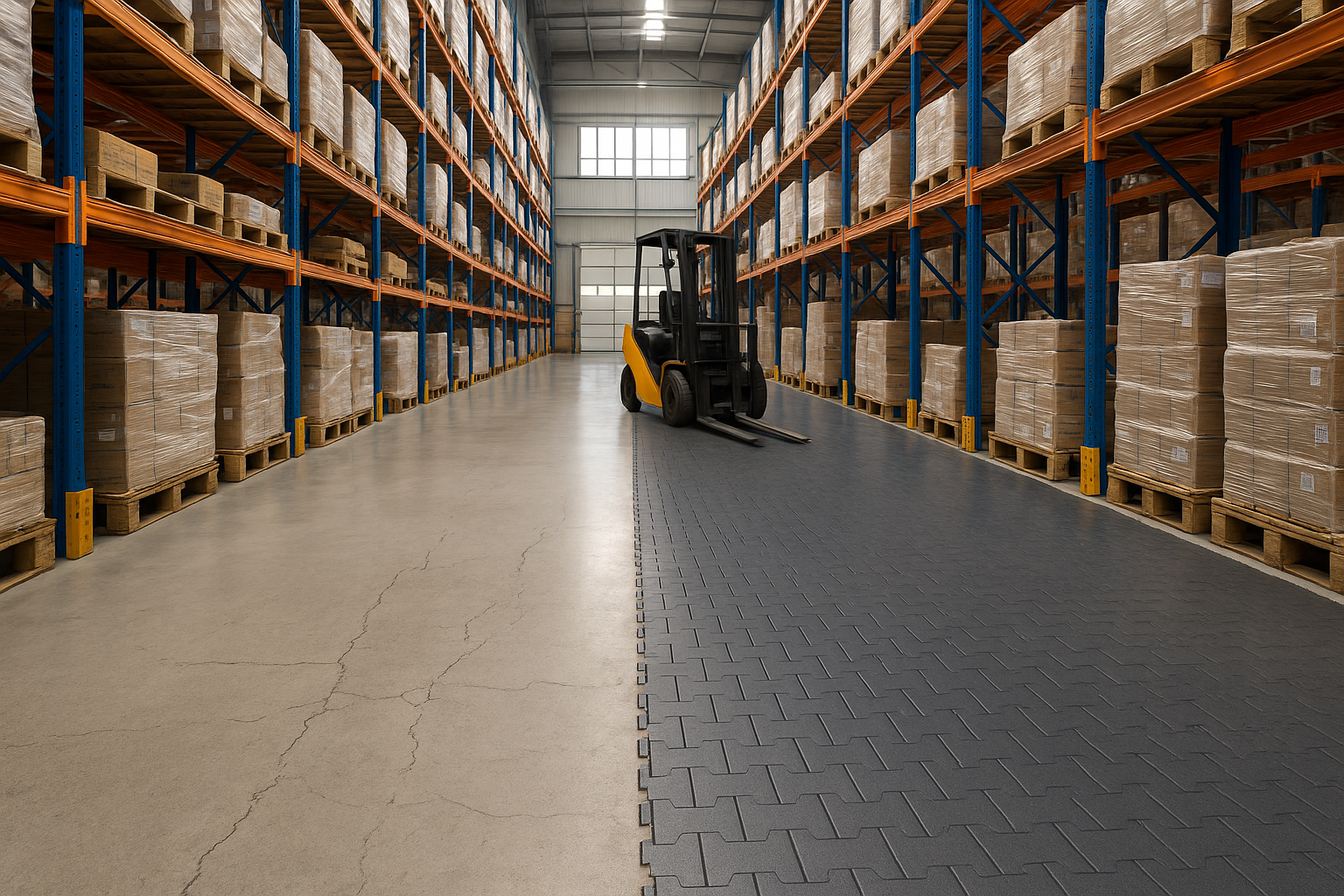
Epoxy vs PVC Flooring: Complete Comparison for Indian Factories & Warehouses
When you upgrade a factory or warehouse floor, the discussion usually starts with epoxy. It has been a default choice in India for decades, and in the right application it remains a strong one. But as operational demands rise and the cost of production downtime climbs, more plant managers are asking: which is better, epoxy or PVC tiles?
This isn’t a theoretical debate. Choosing the wrong flooring means dealing with cracked concrete, trip hazards, stalled forklifts, and repeated shutdown costs over the next five years.
If you are weighing epoxy vs PVC flooring, this guide gives you an objective comparison. As a manufacturer of heavy-duty PVC interlocking tiles, we have a clear perspective — but we also tell you plainly when epoxy is the right fit and our product is not.
Here is the straight, engineer-to-engineer breakdown of epoxy vs modular tiles — featuring CAMP’s Tiepro® PVC interlocking floor tiles.
What is Epoxy Flooring?
Epoxy flooring is a thermosetting resin that is applied as a liquid coating over a concrete slab. It consists of two main components: a resin and a hardener. When mixed and applied, they undergo a chemical reaction to cure into a rigid, seamless plastic-like surface.
In industrial settings, epoxy is usually applied in multiple layers (primer, body coat, and topcoat) to achieve the necessary thickness and durability. It bonds directly to the concrete beneath it, creating a hard, impermeable seal.
What are PVC Interlocking Floor Tiles?
Industrial PVC interlocking floor tiles are heavy-duty modular squares — moulded from a high-performance engineered polymer composite — manufactured specifically to withstand high impact and heavy loads.
Unlike epoxy coatings, these tiles are not glued to the floor. They use an engineered interlocking joint system (like heavy-duty puzzle pieces) that snaps together with a mallet. Because they are not bonded to the concrete, they “float” over the existing slab. This allows them to absorb impact, handle slight floor movement, and cover over existing damage without requiring the old floor to be demolished or ground down.
Head-to-Head Comparison: Epoxy vs PVC Tiles
To give you the full picture, here is a side-by-side look at the 10 most critical criteria for an industrial environment.
| Criteria | Epoxy Flooring | PVC Interlocking Tiles |
|---|---|---|
| Installation Time | Slow (Multi-step process over days) | Fast (2,000–3,000 sq.ft per shift) |
| Shutdown Needed | Yes (5–7 days for prep and curing) | Minimal (Phased, zone-by-zone install while production continues in unaffected areas) |
| Skill Required | High (Specialist contractor needed) | Low (In-house maintenance can install) |
| Load Capacity | Good (If applied thick enough) | Load-matched by grade and thickness — from pedestrian/light-trolley grades up to heavy-duty 10mm for counterbalance forklift aisles, site-qualified to the actual load |
| Moisture Sensitivity | High (Bubbles and peels if slab is damp) | Low (Breathable joints prevent trapping) |
| Repair Method | Difficult (Grind and re-coat entire section) | Easy (Replace individual damaged tiles) |
| Chemical Resistance | Excellent (Seamless barrier) | Very Good (Tight joints, resistant material) |
| Cost (initial install) | A per-sq.ft rate that varies by system and applicator | Quoted per-sq.ft by grade — site-specific quote only |
| Total cost (5 years) | Higher in heavy-traffic zones (repair + downtime cycle) | Lower (minimal-shutdown install + tile-level repair) |
| Heavy-traffic service | Re-coat cycle in high-wear zones | Long service life before replacement — grade-tiered warranty |
Installation & Downtime — Where PVC Tiles Win Clearly
When comparing interlocking tiles vs epoxy, the most dramatic difference is what happens to your production schedule during installation.
Epoxy requires aggressive surface preparation. Contractors must shot-blast or diamond-grind the existing concrete to create a profile the resin can grip. The floor must be absolutely dry and dust-free. After the primer and coats are applied, the chemical curing process takes 5 to 7 days before you can safely drive a forklift on it. For a 10,000 sq.ft zone, that means a full week of zero production.
PVC tiles skip this entirely. There is no grinding, no dust, and no curing time. The floor is ready for heavy traffic the second the tile is tapped into place. A trained team can install 2,000–3,000 sq.ft in a single 8-hour shift, working zone-by-zone while the rest of your factory continues to operate.
Durability & Repairs — The Crucial Difference
Epoxy is incredibly hard, but it is also rigid. If you drop a heavy steel die onto an epoxy floor, the coating will chip. When a heavy forklift turns repeatedly in the same aisle, the rigid surface often cracks—especially if the concrete slab beneath it expands or shifts due to thermal changes. Once cracked, the only way to repair epoxy is to grind down the damaged section and re-pour it, which creates a visible patch and requires another shutdown.
PVC is tough but flexible. It absorbs the shock of a dropped tool without chipping. If a 3-tonne counterbalance forklift turns sharply, the tile handles the shear force. And in the rare event a tile is severely damaged (like a deep cut from a dragged metal pallet), you simply lift that specific tile and tap a new one in. The repair takes five minutes and costs the price of one tile.
Cost Comparison — Why Total Cost Matters More Than Price Per Sqft
When plant managers look at pvc tiles vs epoxy cost, they often only look at the initial quote.
A standard 2mm epoxy coat carries a lower per-sq.ft material rate than a heavy-duty 7mm PVC tile. On paper, epoxy looks cheaper.
But calculate the Total Cost of Ownership (TCO). To install the epoxy, you must shut down production for the cure window. What is the financial value of that lost output in your facility? When the epoxy later wears or cracks under forklift traffic in a heavy-traffic zone, you pay the install rate again to re-coat it — plus another stretch of lost production. The right comparison is the 5-year operating cost, not the headline per-sq-ft rate.
With PVC tiles, the initial material cost is higher, but the install is minimal-shutdown — phased zone-by-zone while production continues in unaffected areas — and the floor delivers a long service life, backed by a grade-tiered warranty, with tile-level repair instead of full replacement. Across a 5-year window in a heavy-traffic zone, that typically lands in PVC’s favour. Share your floor area and output value and we will frame the comparison on your numbers — we do not publish a blind rate.
Chemical & Oil Resistance — How They Differ
If you run a facility with constant, heavy chemical exposure—like an API pharma plant or a chemical processing unit—epoxy has a distinct advantage. Because it is poured as a liquid, it cures into a 100% seamless barrier. There are no joints for harsh chemicals to seep into.
PVC tiles are highly resistant to standard industrial oils, machine coolants, brake fluids, and mild solvents. The interlocking joints are incredibly tight. However, they are not 100% watertight. If you have a facility where large volumes of aggressive acids are frequently dumped onto the floor, a seamless epoxy or PU screed is a safer choice.
Safety — Slip, Static, and Fire Rating Comparison
A clean, dry epoxy floor looks spectacular. But a wet or oily epoxy floor is highly dangerous. To make epoxy slip-resistant, contractors must broadcast silica sand or quartz into the topcoat. Under heavy forklift and foot traffic, this aggregate wears smooth within a year, returning the floor to a slip hazard.
PVC tiles are manufactured with a textured surface (often a studded or coin finish) that provides slip resistance built into the tile itself, rather than a sacrificial topcoat aggregate. The grip holds up consistently under wet or lightly oiled conditions — the tile is independently rated R10 (DIN 51130:2014), certificate on file. Fire rating is built into the product grade: Standard (5mm) is FR (LOI 25–27%); Premium (5mm) is EN 45545-2 R10 HL1 (LOI 28–30%); Super-Premium (5mm) is EN 45545-2 R10 HL2 (LOI 30–32%); 7mm and 10mm grades are FR++ / FRLS · EN 45545-2 R10 HL1; XHD is FR++ / FRLS · EN 45545-2 R10 HL2. Certificates on file (Ignito Labs — HL1 2022, HL2 2025). The Commercial grade is not fire-rated. Anti-static (ESD) variants are available; ESD performance is gated and confirmed against test documentation on request. PVC retains its anti-slip surface far longer than a broadcast-aggregate epoxy.
When Should You Choose Epoxy? (Honest Answer)
We don’t believe in selling you tiles if they aren’t the right fit. You should choose a properly specified epoxy or PU screed if:
- You need a 100% seamless, sterile environment: Think cleanrooms, pharma manufacturing, or food processing areas that require daily high-pressure chemical washdowns.
- You have constant, pooling chemical spills: If harsh acids regularly pool on the floor, you need a seamless chemical barrier.
- You have a very tight initial budget and light traffic: If you just need to seal a pedestrian walkway and cannot afford the upfront cost of tiles, a basic epoxy coat will work temporarily.
When Should You Choose PVC Interlocking Tiles?
PVC interlocking tiles are a strong fit for most heavy industrial environments. Tiepro® tiles are likely the right call if:
- You cannot afford production downtime: if shutting a zone for the epoxy cure window is unacceptable, the phased dry-lay install is a decisive advantage.
- You have heavy forklift traffic: matched to grade and thickness, PVC absorbs point-load stress and turning forces that crack rigid coatings.
- Your current concrete is damaged or damp: tiles install directly over cracked concrete, sound failing epoxy, or a damp-prone slab without demolition.
- You want a recoverable, long-life floor: a floor built for a long service life, repairable tile-by-tile, relocatable, and fully recyclable at end of life — even after 10+ years.
Frequently Asked Questions
Is PVC flooring more expensive than epoxy?
On upfront material cost, heavy-duty PVC tiles are generally more expensive than a basic 2mm epoxy coat. But once you factor in the production downtime required to install epoxy and the recurring re-coat cycle in heavy-traffic zones, the 5-year total cost of ownership often favours PVC. The honest answer depends on your traffic and output value — share your floor area and we will frame the comparison; we do not publish a blind rate.
Can I install PVC tiles over an existing epoxy floor?
Yes. This is the most common installation scenario. As long as the floor is structurally stable, PVC tiles are installed directly over the failing, peeling epoxy. There is no need to grind the old epoxy off.
Does PVC flooring last as long as epoxy?
In a heavy industrial setting, PVC typically outlasts an epoxy topcoat, which wears or cracks under sustained forklift traffic and needs periodic grinding and re-coating. CAMP’s Tiepro® 7mm and 10mm PVC interlocking tiles are built for a long service life under the same conditions and are backed by a grade-tiered manufacturer’s warranty (the 7mm and 10mm grades carry the longest terms — request your product-specific terms with your quotation).
Which is better for forklift areas — epoxy or PVC tiles?
PVC tiles are well suited to forklift areas when the grade and thickness are matched to the load — heavier industrial grades for pallet-truck traffic, and a 10mm heavy-duty grade for counterbalance forklift aisles, with site-specific qualification for critical or dynamic loads. Epoxy is rigid and brittle; it cracks under the point-load pressure of forklift tires, especially when they turn. PVC is flexible and absorbs the impact and shear forces without cracking.
Can PVC tiles be removed and reused?
Yes. Because they are not glued to the floor, you can unlock the tiles and take them with you if you move to a new leased facility, or easily reconfigure your floor layout if you change your assembly lines.
Which is better for damp or wet factory floors?
PVC tiles are vastly superior for damp concrete. Epoxy is a non-porous sealant; if there is moisture in the concrete slab, it will eventually build up pressure and cause the epoxy to peel and bubble. PVC tiles have breathable joints that allow sub-floor moisture to evaporate naturally without damaging the floor.
Not sure which is right for your facility? Share your floor details, forklift load, and current floor condition with us on WhatsApp. We will give you a straightforward recommendation — even if that means telling you epoxy is the better fit for your application. See the full Tiepro® PVC interlocking floor tile range and load-matched grades.
See the full head-to-head comparison: Epoxy vs PVC Interlocking Floor Tiles — India’s Most Complete Industrial Flooring Comparison →


